

Most commercial property owners think about their roof exactly twice in its lifespan: when they buy the building (and the inspection report mentions it), and when it starts leaking. By the time it’s leaking, the cheapest, easiest opportunities to extend the roof’s life are long gone.
A simple preventive maintenance plan changes that math entirely. For roughly the cost of a cheap dinner per square foot per year, a flat roof that would have lasted 18 years can last 30+. For a 20,000 square foot warehouse, that’s the difference between a $250,000 roof replacement in 2032 and one in 2045 — plus avoiding the emergency leak repairs and interior damage in between.
This article walks through what preventive maintenance actually is, why it works so well on flat roofs, and what a sensible plan looks like for a Pennsylvania commercial property.
Why flat roofs reward maintenance more than pitched roofs
A pitched asphalt shingle roof on a residential home is largely sealed from above by gravity — water runs off quickly and doesn’t have many opportunities to enter the system. When shingles age, they fail visibly, and replacement is the standard answer.
A flat roof is different. Water sits on it longer, drains through specific points (drains, scuppers, gutters) that can clog, and is held back from entering by the integrity of seams, flashings, and membrane connections. Many of the things that cause flat roof failure are reversible — if you catch them early.
The key insight: most flat roof failures are local. A failed seam, a clogged drain, a deteriorated flashing detail, a single puncture — these are not membrane-wide failures. Caught early, they’re inexpensive repairs. Left ignored, they become leaks. Leaks become saturated insulation. Saturated insulation becomes interior damage and full membrane replacement.
What preventive maintenance actually means
A real preventive maintenance plan has four components.
- Scheduled visual inspection — typically twice a year (spring and fall).
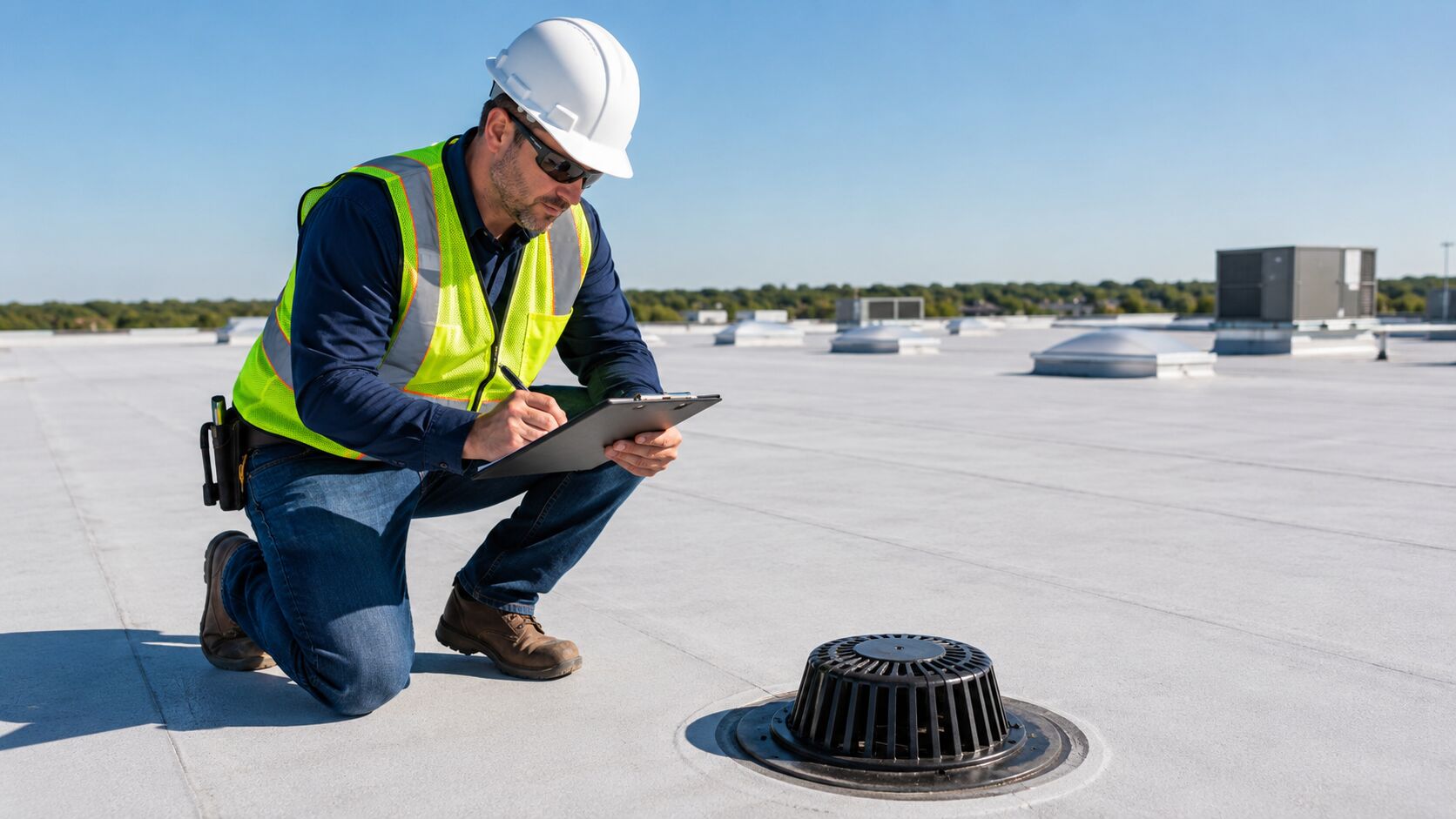
A roofer walks the entire roof, looks at every seam, every penetration, every flashing detail, every drain. Photos are taken. Any issues are documented in a written report.
- Routine cleaning and clearing.
Drains, scuppers, and gutters are cleared of leaves, debris, and any accumulation that obstructs drainage. This single step prevents a huge percentage of all flat roof problems. Clogged drains cause ponding, ponding accelerates degradation, and degradation causes failure.
- Targeted minor repairs.
Issues identified during inspection are addressed promptly while they’re still small — a re-welded seam, a sealed flashing, a refastened edge metal. The cost of these small repairs is a fraction of what they cost after they’ve grown into full leaks.
- Documentation and budgeting forecast.
The owner or property manager receives a written annual report on roof condition, with a forecast of any larger work likely needed in the coming 1, 3, and 5 years. This lets you plan and budget rather than reacting to emergencies.
What it costs
Preventive maintenance pricing is typically structured on a per-square-foot annual basis. As a guide:
- Standard preventive maintenance plan: typically $0.10 to $0.25 per square foot per year, depending on roof complexity.
- That’s $2,000 to $5,000 per year on a 20,000 square foot warehouse.
- Compare to a full roof replacement at $7 to $12 per square foot — a preventive plan extends the life of a roof installed at $150,000+.
Many plans pay for themselves multiple times over by extending the roof’s useful life and avoiding emergency repair premiums.
What you get back
For commercial property owners, the benefits compound:
Longer roof life. We routinely see flat roofs reaching 30+ years on properties with proper maintenance. The same roofs without maintenance often need replacement at 18 to 20 years.
Lower total cost of ownership. The math on a 20,000 sq ft TPO roof:
- Without maintenance: Replacement at year 18, cost $200,000+.
- With maintenance ($3,500/year): Replacement at year 30, total maintenance investment $42,000, replacement still costs $200,000+ but pushed out 12 years.
- Net: Avoiding a roof replacement for 12 years easily justifies the maintenance cost, and the maintenance also prevents the $20,000 to $50,000 in emergency repairs that typically happen between year 15 and full replacement.
Avoided business disruption. Emergency leaks during business hours mean tenant complaints, water damage to inventory or equipment, insurance claims, and the cost premium of emergency contractor calls. Maintenance turns roof issues into scheduled non-events.
Better tenant relations. Commercial tenants notice when the building is maintained. Roof problems lead to lease disputes, rent abatements, and turnover. Buildings with maintained roofs lease better and renew better.
Insurance considerations. Some commercial insurers offer reduced premiums or favorable terms for buildings with documented preventive maintenance plans. Some require it for higher-value properties. Documented inspection records also help significantly when a claim does happen.
Manufacturer warranty preservation. Most commercial roofing manufacturer warranties require periodic inspection and maintenance to remain valid. A maintenance plan with documented records keeps the warranty enforceable when you need it.
What’s not preventive maintenance
A few things that get sold as “maintenance” but aren’t:
- A free annual roof inspection by a contractor whose real interest is selling you a replacement. The incentive is wrong.
- Annual roof “treatments” with proprietary coatings sold at high markup. Most flat roof systems don’t need annual coating; they need inspection and targeted repair.
- A drive-by visual check from the parking lot. That’s not an inspection. A real inspection means walking the roof.
A genuine maintenance plan is a written contract that specifies what’s inspected, what’s cleaned, what’s repaired (and within what cost limits without re-approval), and what reporting you get back.
When to set this up
The best time to start preventive maintenance is when the roof is new — that’s when extending its life has the highest dollar value over the longest period. The second-best time is now, on whatever roof you currently have. Every year of preventive maintenance you add starts paying off immediately.
For an existing aging roof, the first inspection establishes baseline condition and identifies any urgent repairs needed before maintenance can effectively extend life.