

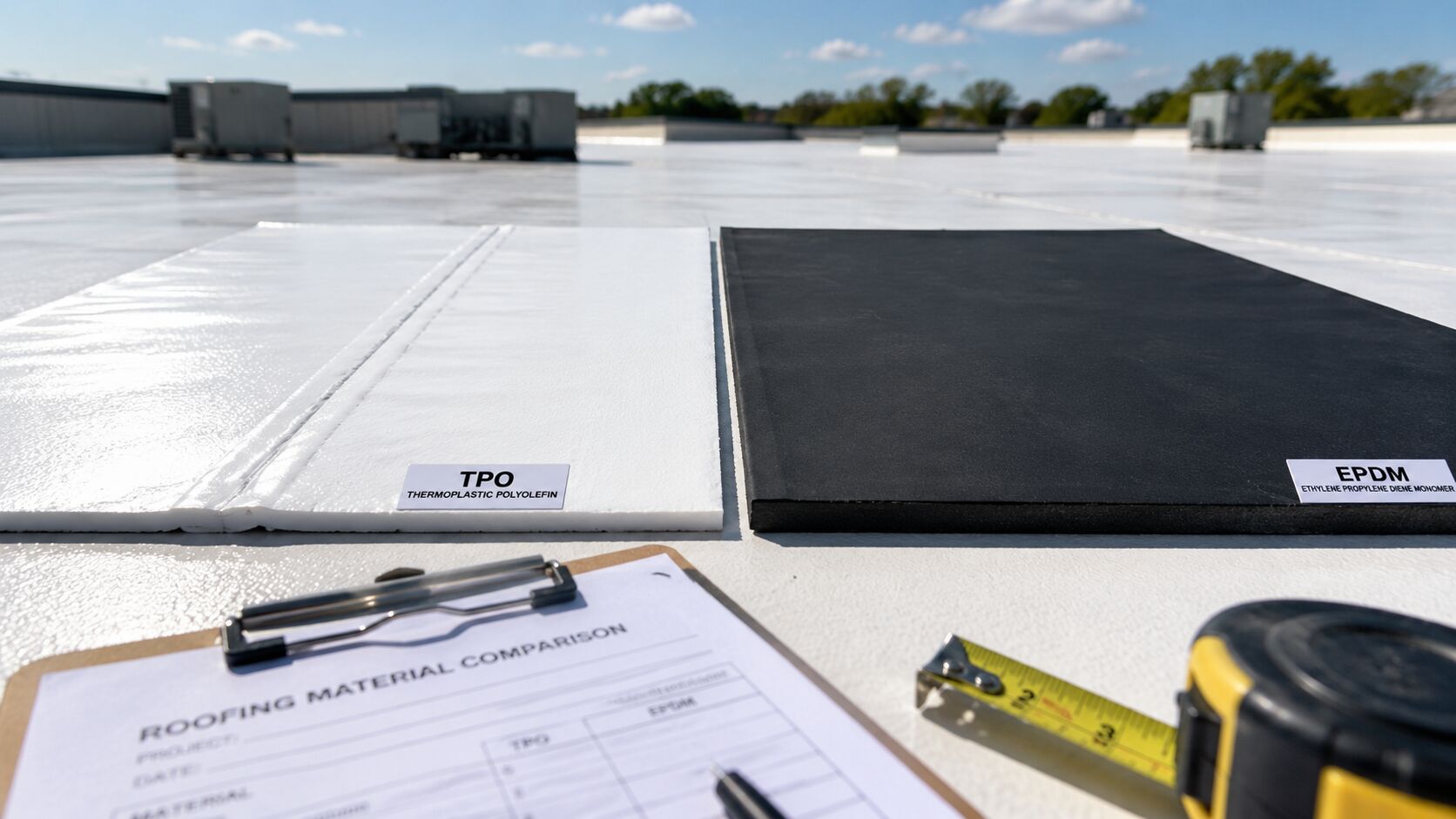
If you own a commercial building, an industrial facility, or a residential property with a flat or low-slope roof in Pennsylvania, sooner or later you’ll face the decision: TPO or EPDM. These are the two dominant single-ply membrane systems on the market, and both are excellent — when correctly specified and installed.
But they are not interchangeable. The right answer depends on your building, your climate exposure, your budget, your timeline, and what you want from the roof over the next 20 to 30 years.
This article walks through the practical differences between TPO and EPDM in plain language, with the Pennsylvania climate in mind.
What TPO and EPDM actually are
TPO (thermoplastic polyolefin) is a synthetic single-ply membrane introduced commercially in the 1990s. It’s typically white or light-colored, reflective, and installed in long rolls heat-welded together at the seams. The membrane is reinforced internally with a polyester scrim for tear strength.
EPDM (ethylene propylene diene monomer) is a synthetic rubber single-ply membrane that has been in use since the 1960s. It’s typically black, available in white, and installed in large sheets bonded to the substrate. Seams are joined with seam tape and primer rather than heat-welded.
Both are mature, proven systems. Manufacturer warranties range from 15 to 30+ years on either system, depending on thickness and configuration.
Climate performance in Pennsylvania
Pennsylvania presents a specific climate challenge: cold winters with significant freeze-thaw cycles, snow accumulation, summer heat with strong UV exposure, and occasional severe storms. How do these systems handle that?
EPDM in cold climates
EPDM is the older, more cold-tested system in our region. It remains flexible at very low temperatures (down to -40°F) and has a long track record of surviving Pennsylvania winters. The thermoset rubber chemistry doesn’t become brittle the way some thermoplastics can. For a building that will see decades of freeze-thaw cycling, EPDM is a proven survivor.
The black color of standard EPDM also has a winter benefit: it absorbs solar heat in winter, helping to melt snow and ice and reducing ice dam risk. (In summer this same property increases cooling load — a tradeoff.)
TPO in cold climates
TPO has a shorter track record in PA winter conditions, but the systems on the market today are formulated specifically for cold-climate performance. Quality TPO membranes from established manufacturers handle PA winters well when properly installed — meaning seam welds done correctly at the right temperature with proper probe testing.
The reflective white surface significantly reduces summer cooling costs, and TPO maintains good UV resistance over time. The cold-temperature performance of TPO depends heavily on installation quality and the specific manufacturer; not all TPO is equal.
Energy efficiency
This is where TPO has a clear advantage for buildings that run air conditioning in summer.
- A white TPO roof can reflect 70 to 80 percent of incoming solar radiation.
- A black EPDM roof reflects roughly 5 to 10 percent.
For a commercial building with significant cooling load — warehouses with heat-sensitive inventory, retail with high HVAC demand, office buildings with computer-heavy operations — the cooling cost reduction from TPO can be substantial. We have seen 10 to 25 percent cooling cost reductions reported by clients after TPO replacement of dark roofs.
For a residential addition with no air conditioning above it, this difference is largely irrelevant.
Cost
For comparable installation quality, EPDM is typically slightly less expensive than TPO on a per-square-foot installed basis. The exact gap depends on thickness, membrane manufacturer, and project specifics, but EPDM commonly comes in 10 to 20 percent below TPO.
For a homeowner replacing a 1,000 sq ft flat roof, that’s a few hundred to a thousand dollars in difference. For a 30,000 sq ft commercial building, it’s tens of thousands of dollars. The decision becomes more important at scale.
Lifespan
Both systems can deliver 25 to 35+ years of service when properly installed and maintained. Real-world performance depends on:
- Installation quality (this matters more than the membrane choice)
- Proper substrate preparation
- Correct flashing details at penetrations and edges
- Routine maintenance (debris removal, drain clearing, seam inspection)
- Climate exposure and rooftop traffic
A poorly installed TPO roof can fail in 8 years. A well-installed EPDM roof can perform for 35 years. The contractor matters more than the membrane.
Repairability
EPDM is somewhat easier to repair on the back end. Seam tape, splice patches, and cover tape are simple field repairs. TPO repairs require either heat welding or specialized repair products that bond reliably to TPO membranes — meaning a TPO roof generally needs a TPO-experienced contractor for repairs.
If your roof is going to be repaired by general handymen rather than a roofing specialist, EPDM is the friendlier choice. If you’re going to call your roofing contractor for repairs, the difference shrinks.
Installation considerations
TPO seams are heat-welded — a mechanical fusion of the membrane material itself. When done correctly, this seam is as strong as the membrane elsewhere. When done incorrectly (wrong temperature, insufficient pressure, inadequate probing), the seam can fail prematurely. The contractor’s TPO experience matters significantly.
EPDM seams are tape-bonded with cleaner-primer. This is more forgiving — the technique is simpler and less temperature-sensitive — but the seam material is fundamentally different from the membrane itself. Tape failure is a recognized long-term EPDM issue, though manufacturers have improved tape chemistry significantly over the years.
For owner-operators in our region: if your contractor has decades of EPDM installation history but limited TPO history, EPDM may be the safer specification. For new commercial construction with a manufacturer-certified TPO contractor, TPO is often the better choice.
So which one should you choose
For most PA commercial buildings with significant cooling load: TPO has the edge. Energy savings, modern manufacturer warranties, and reflective surface make it the dominant choice for new commercial work.
For PA residential additions, dormers, and small commercial projects: EPDM is often the better practical choice. Lower cost, simpler repairs, proven cold-climate performance, and excellent value.
For replacement of an aging EPDM roof on an established commercial building: matching with EPDM keeps existing flashings, edge details, and maintenance practices consistent. Switching to TPO is justifiable if energy savings are a priority but adds project complexity.
For agricultural or industrial buildings with chemical or grease exposure: confirm chemical compatibility with both systems before specifying. Some petroleum-based exposures degrade EPDM faster than TPO.