

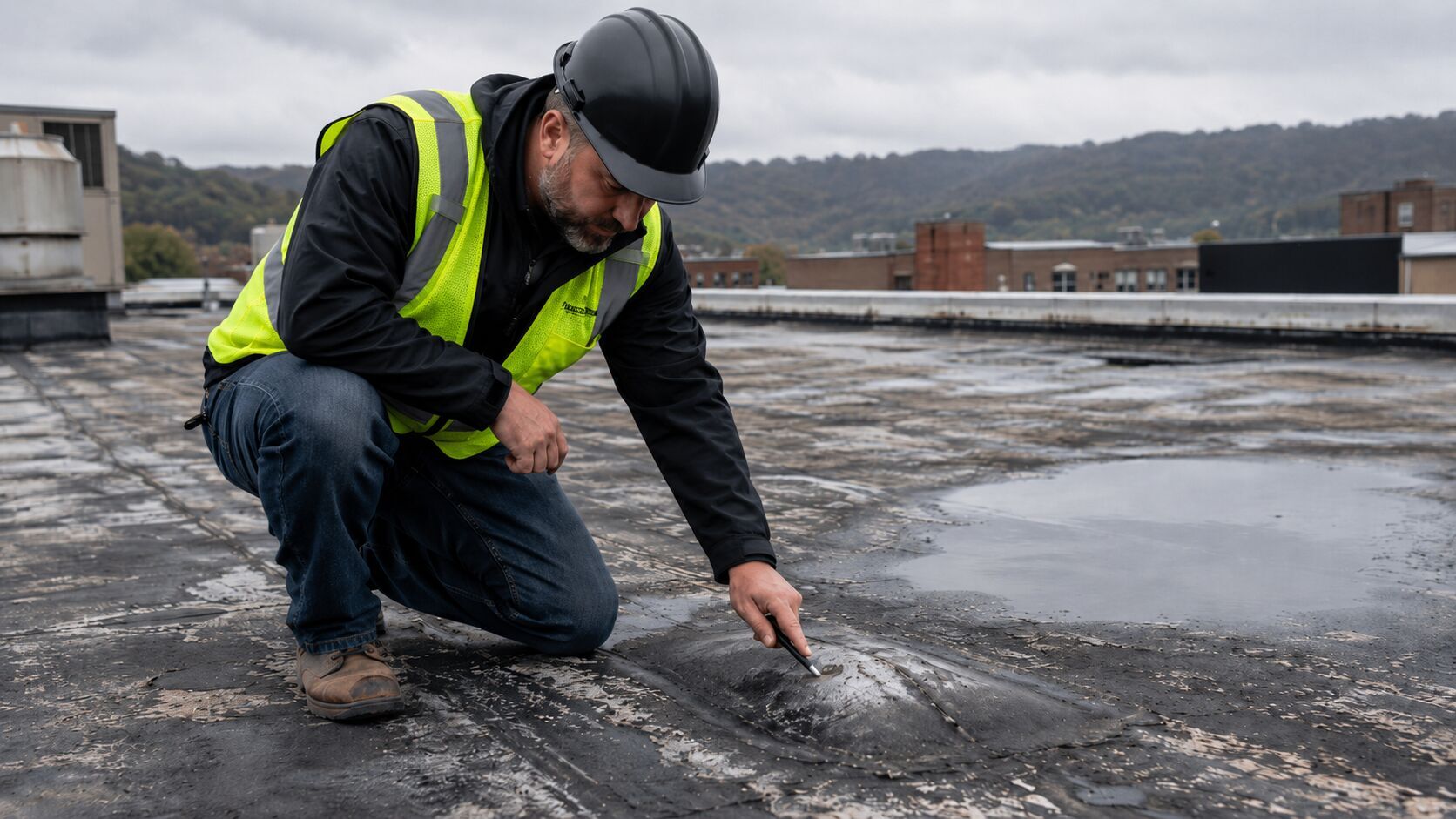
A flat roof rarely fails all at once. It usually warns you for months, sometimes years, before active leaks begin. The owners who recognize the warning signs early — and act on them — save themselves thousands of dollars in interior damage, mold remediation, and emergency repair premiums.
Below are the seven warning signs we see most often as roofers in Pennsylvania, in roughly the order of urgency. If you’re seeing any of these on your commercial or residential flat roof, schedule an inspection.
- Bubbles, blisters, or ridges in the membrane
What you’ll see: Raised areas on the roof surface, ranging from a few inches across to several feet, where the membrane has separated from the substrate or expanded with trapped air or moisture.
What it means: The membrane is no longer fully bonded to what’s underneath. Trapped moisture, vapor pressure, or adhesion failure has caused the separation. Once a bubble is present, the membrane in that area is much more vulnerable to puncture, UV degradation, and seam failure.
What to do: A roofer can assess whether the bubble is a localized issue (often repairable with a strategic cut and re-bond) or a sign of widespread substrate moisture (which requires more extensive work). Either way, leaving large bubbles untreated typically leads to leaks within 1 to 3 years.
- Visible seam separation or lifting
What you’ll see: Where two pieces of membrane meet, you can see a gap, lifting edge, or separation. On TPO this might look like a partially open seam; on EPDM, lifting tape; on modified bitumen, an open lap.
What it means: This is the most common path for water entry on flat roofs. Seams are the weakest part of any membrane system, and seam failure means you have a leak in the making.
What to do: Schedule a repair immediately, before water gets in. A skilled roofer can re-weld TPO seams, retape EPDM splices, or torch-reseal modified bitumen. Small seam failures caught early are inexpensive to fix; the same failures that have been leaking for a year and saturated insulation cost ten times as much to address.
- Pooling water that doesn’t drain within 48 hours
What you’ll see: After a storm, water remains pooled on certain areas of the roof for two days or more, even after surrounding areas have dried.
What it means: Either the drainage is blocked, the slope was inadequate from the start, or the roof structure has settled and created low spots. All flat roofs are designed to drain — they’re not actually flat, just low-sloped. Standing water accelerates membrane degradation, encourages algae and biological growth, and increases the risk of water entry through any small membrane defect.
What to do: First, check that drains, scuppers, and gutters aren’t blocked. Cleaning them often resolves the issue. If the pooling continues despite clear drainage, the roof needs evaluation. Long-standing ponds (called “ponding”) usually require either tapered insulation to redirect water, drain repositioning, or in severe cases, a full roof replacement.
- Soft spots or sponginess underfoot
What you’ll see: When walking on the roof, certain areas feel soft, spongy, or compressible compared to firm areas elsewhere.
What it means: The insulation under the membrane has gotten wet and has lost its structural integrity. This is a serious sign — it means water has been entering the system for some time, possibly a long time, even if you haven’t seen interior leaks yet. Wet insulation also represents lost R-value, increasing heating and cooling costs.
What to do: Have a roofer perform a moisture survey. Wet insulation typically requires removal and replacement; the membrane above can sometimes be saved if caught early, but more often the system needs full replacement of the affected sections. The longer you wait, the more area is affected.
- Interior water stains or active dripping
What you’ll see: Stains on ceilings or interior walls, water damage in the upper floor, or active dripping during rain. Sometimes the stain is far from the actual entry point — water travels along structural members before becoming visible.
What it means: Water has been entering the building for some time. By the time interior staining is visible, the leak has typically been happening for weeks or months. Mold growth in the wall and ceiling cavities is likely.
What to do: Call a roofer immediately. Tarp the affected area if a storm is approaching. The longer water continues entering, the more interior damage and the more remediation work after the leak is fixed.
- Cracking, alligatoring, or surface degradation
What you’ll see: The membrane surface shows a network of fine cracks, like the back of a dried mud flat or alligator skin. Granules (on modified bitumen) are washing into gutters. The surface looks chalky, faded, or visibly weathered.
What it means: The membrane is reaching the end of its service life. UV exposure has degraded the surface, and the membrane is becoming brittle. Once cracking is visible, the roof is on borrowed time — waterproofing performance is compromised, and the next significant weather event may produce the leak.
What to do: This is generally a replacement situation, not a repair. A targeted patch can buy a year or two on isolated cracking, but widespread surface degradation means the membrane chemistry is failing across the whole roof. Plan for replacement and budget accordingly.
- Failed or missing flashing at penetrations and edges
What you’ll see: At the edges of the roof, around vent stacks, around HVAC curbs, and where the roof meets walls or chimneys — the metal flashing or membrane termination is loose, missing sealant, rusted, separated from the wall, or visibly damaged.
What it means: Flashings handle the most complex waterproofing details on the roof. They are also the most common point of failure. A failed flashing at a parapet wall, an HVAC unit, or a vent pipe is one of the most common sources of leaks on otherwise sound roofs.
What to do: Flashing repair is typically a manageable, cost-effective intervention. A roofer can rebuild the flashing detail with new metal, fresh sealant, and properly integrated membrane termination. Catching this early keeps it from becoming a major leak that destroys the membrane around it.
When to call a professional
If you’re seeing one of these signs and you’re unsure how serious it is, schedule a roof inspection. A competent roofer can tell you whether you’re looking at a $300 repair, a $3,000 repair, or a $30,000 replacement — and give you the information you need to plan.
What we don’t recommend: ignoring it, applying random patching products from the hardware store, or hiring a generalist handyman to “look at it.” Flat roofing is a specialty discipline. The repair done correctly, the first time, by a contractor who works on flat roofs every day, will last. The repair done by someone applying roof tar with a stick will create a worse problem within a year.